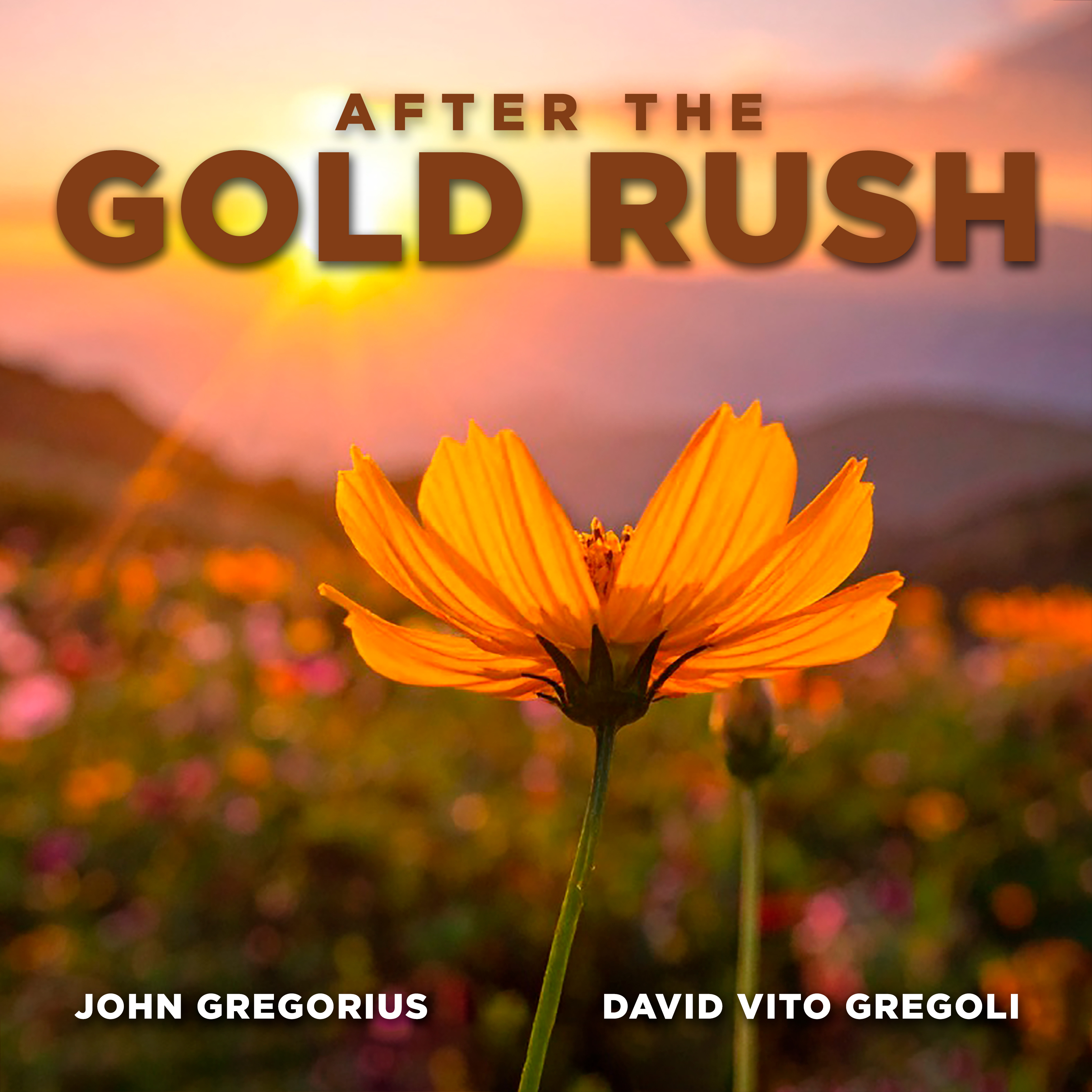
After The Gold Rush by John Gregorius and David Vito Gregoli
Ambient guitar meets new age fingerstyle guitar and creates a whole new world of chill.
After The Gold Rush by John Gregorius & David Vito Gregoli
review by Steve Sheppard of One World Music
What do you get when you combine the talents of two of today’s finest mul7-
instrumentalists and allow them free reign over your senses? well magic is
made. A breath taking and refreshing global look can be found at the end of an
overarching contemporary music genre moment, that is brought into full focus
by listening to the latest release called A"er The Gold Rush by John Gregorius
& David Vito Gregoli.
This 5 track release is a smooth instrumental collec7on of fresh, new and
fascina7ng crea7ons with the ever talented duet, from the very first track
called Moving Across Land we are giCed a progressive and ever onward
composi7on that reverberates around the fretless bass and dances with the
percussion in a beau7fully rhythmic opening offering.
One of my favourite tracks from the album is now upon us and en7tled The
Gentle Glide To Freedom. The is a delicious and gentle ride to a freedom of
tone and 7mbre, the soCness of touch here is simply idyllic, the delicate
percussion and guitar for me, all go to make up one of the stand out pieces
from the release, one that has a touch of reflec7on built nicely into the weave,
also note the acous7c guitar in this track it is so beau7fully played.
The Power Of Myth is a subject I was only having a discussion about yesterday
in a mee7ng, it has such a strong pull on our ways of thinking and beliefs, but
with regard to the context of this song one can feel a sense of palpable care
being taken within the weave of this quite emo7onal offering, the bass and
guitar manifest an emo7onal juxtaposi7on for us all to enjoy.Now if you have never heard this track before, where on earth have you been!
Originally released by Neil Young back in 1970 this classic composi7on is given
a breath of fresh life from the mul7-instrumenta7onal genius of John Gregorius
& David Vito Gregoli. The fretless bass and guitar replace the harmonics and
vocals stunningly, and the rhythmic pas7che of percussion adds further weight
to the conclusion, that this may well be one of the best instrumental versions
of this song ever.
Our final piece which concludes the release is called Upending, once more the
guitar is transcendent and mul7-layered, when the bass kicks in the en7re
piece gains a founda7on and sings with the duel guitars in one of the most
soothing ending final offerings I have heard for quite some 7me, the added soC
keyboards and percussion bring much to the table also on this final
arrangement.
A"er The Gold Rush by John Gregorius & David Vito Gregoli is a thoroughly
enjoyable listen, the inven7veness of the art work contained musically within
this release is outstanding, the recording and produc7on doubly so. It’s well
cited that these ar7sts are well known and musically respected as classy mul7-
instrumentalists, but this symbiosis of sound gives us all that and more, a
pleasurable experience to bathe within as instrumental magic is created by
listening to A"er The Gold Rush by John Gregorius & David Vito Gregoli.
JOHN GREGORIUS - DAVID VITO GREGOLI, After the Gold Rush by Jonathan Widran for JW Vibe:
David Vito Gregoli and John Gregorius’ collaborative EP After the Gold Rush unfolds less like a
traditional ambient recording and more like a slowly evolving landscape study—five intricately
sculpted instrumental pieces that blur the boundaries between acoustic intimacy, atmospheric
immersion and exploratory world music textures. Though both artists have long established deeply
personal sonic identities on their own, the project succeeds most powerfully because neither simply
overlays his signature approach onto the other’s. Instead, the duo creates a shared language rooted in
spaciousness, curiosity and patient melodic development.
There’s also a deeper lineage quietly guiding the project. The title track is an homage to
Michael Hedges and Michael Manring’s haunting instrumental interpretation of Neil Young’s “ After the Gold Rush,” first heard on Hedges’ landmark 1984 album Aerial Boundaries. Gregoli openly acknowledges the reverence—and risk—in revisiting such sacred terrain. “To attempt to do it was a bit of hubris,” he admits, “but really it’s an homage to the inspiring work the two Michaels did together.”
Yet rather than attempting imitation, Gregoli and Gregorius channel the adventurous spirit of that collaboration into something more expansive and contemporary, honoring the emotional architecture of the original while reshaping it through their own ambient, post-rock and world music sensibilities.
The partnership itself began with charmingly modest intentions. Gregoli jokes that he initially reached
out to Gregorius because “it’d be fun to have a track from two people with such similar last names,”
but the collaboration quickly deepened once he immersed himself more fully in Gregorius’ music. “ As
with all my collaborations,” Gregoli explains, “it’s about how do we do something unique that doesn’t
sound like the solo material we’ve done before — greater than the sum of the parts.”
That philosophy permeates every moment of After the Gold Rush. Gregorius—whose ethereal-
ambient guitar work has become a staple on Echoes radio and SiriusXM Spa—brings his gift for
shimmering electric textures, flowing acoustic fingerstyle and vast cinematic atmosphere. Gregoli, the
veteran “sound painter” whose career has spanned new age, world music, film scoring and spiritually
infused conceptual works like Song Divine, grounds those textures with fretless bass, exotic
instrumentation, subtle percussion and richly layered ambient design.
The opening track “Moving Across Land” immediately establishes the EP’s immersive vocabulary.
Gregorius’ gently strummed acoustic guitar and hypnotic electric melodies drift over Gregoli’s earthy
percussion and fluid fretless bass lines, creating a piece that feels simultaneously meditative and
restless, as though tracing a slow journey across open terrain. As the arrangement deepens, Gregoli’s
exploratory bass work becomes almost conversational with the intertwining guitars, while piano
accents and swelling ambience gradually widen the sonic-atmospheric horizon without ever
disrupting the piece’s calm momentum.
“The Gentle Glide to Freedom” may be the EP’s most graceful balancing act between atmosphere and melody. Gregorius alternates between tender electric guitar phrasing and delicate acoustic motifs while Gregoli layers Puerto Rican cuatro, mandolin, nylon-string guitar and subtle synth textures beneath the surface. The result is richly sensory yet remarkably uncluttered, evoking images of ocean air, drifting clouds and solitary reflection. The inclusion of birds and environmental soundscapes at the close never feels decorative; instead, it reinforces the duo’s instinctive connection between natural space and musical space.
On “The Power of Myth,” the duo ventures into darker and more mysterious territory. Looming
ambient washes surround Gregorius’ snappy acoustic phrases while Gregoli’s fretless bass winds
beneath the arrangement with a thoughtful, almost narrative quality. The track continuously shifts
between light and shadow, organic warmth and drifting electronic abstraction. Even at its most
atmospheric, however, the composition retains a strong melodic spine, preventing it from dissolving
into mere texture.
The centerpiece remains the title track itself, a haunting reinterpretation that honors Hedges and
Manring without becoming trapped in nostalgia. Gregorius’ stark slide guitar lines carry a lonely,
weathered beauty while Gregoli answers with lyrical fretless bass passages that weave around the
melody with quiet elegance. The gradual layering of acoustic guitars, synth ambience and subtle
percussion transforms the familiar theme into something dreamlike and transportive. Rather than
building toward dramatic climax, the piece unfolds like an extended meditation on memory, influence
and artistic inheritance.
The closing track “Upending” subtly expands the rhythmic vocabulary of the EP. Industrial-leaning
percussion pulses beneath swirling electric and acoustic guitar interplay, while Gregoli’s bass
introduces a darker gravitational pull that gives the composition unexpected weight. Yet even here,
the duo resists excess. The music continues to breathe naturally, allowing silence, sustain and
resonance to remain active compositional elements.
What ultimately makes After the Gold Rush so compelling is the extraordinary restraint both musicians demonstrate throughout. In lesser hands, this many layers of guitars, ambient treatments, percussion textures and global instrumentation could easily become self-indulgent. Instead, Gregoli and Gregorius remain deeply attentive to pacing, space and tonal balance. Every sound feels placed with intention.
For longtime followers of either artist, the EP represents a fascinating convergence of two deeply
atmospheric musical personalities. For newer listeners, it serves as a beautifully rendered entry point
into a style of instrumental storytelling that values patience, immersion and nuance over instant
gratification. Much like the Michael Hedges and Michael Manring recording that inspired it, After the
Gold Rush invites listeners not simply to hear the music, but to inhabit it.